
Radium U 45
Daygas brings together efficient, economical, quality and functional products that give importance to innovation and R&D studies, thus saving energy in the heating sector, with final consumers.
Product features
- Quick start-up.
- Frost protection.
- Low emission ratio.
- High level of safety.
- Safe gas valve system.
- low energy consumption.
- Simple service and assembly.
- Heat resistant non-flammable cable.
- We produce two types of tubelarradium I and U .
- 2 or 5 stage with thermostats or remote control.
- Warm up by radiation without air ventilation.
- Notification of fault and stage on the display screen.


| Capacity | 45 kW |
| Gas Consumption | NG 4,28m³/h / LPG 3,16kg/h |
| Dimensions | 250h / 7200-10200L / 405w |
| Weight | Net 120-175kg / Gross150-220kg |
| Operating Pressure | 21-55mbr NG / 32-55mbr LPG |
| Installation On Height | 320-1000cm |
| Electrical Connection | 230-240VAC 50-60Hz +/-%15 |
| Gas Connection | G ¾’’ |
documents:
Radium Tube Radiant Heaters
Daygas Radium tube type radiant heaters are modern devices designed to heat high ceilings and large volumes. Radium warms the atmosphere by reflecting the heat energy generated by the combustion of the air-gas mixture inside the radiant tubes into the desired environment thanks to parabolic design aluminum reflectors. Radium tube type radiants heat people and objects. This ensures optimal comfort for heating.

Radium Radiant Heaters Pipes


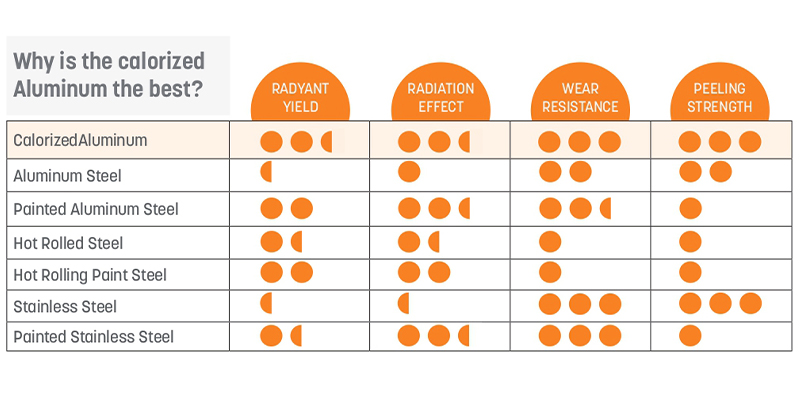
- The tubular radiant heaters use heat treated aluminum steel fillet tubes.
- With pipes, we provide efficient, low capacity, efficient heating to end users.
- Our fillet tubes are tubes for your high performance aluminas. These pipes are made of calorie steel coils to your aluminum.
- From raw to finished pipe, the production process is subject to special processes to show the highest radiation capability in the areas of use.
Radium Radiant Heaters Heat Dissipation
Y.I.B : INTENSE RADIATION ZONE
S.I.B : RARE RADIATION ZONE

- Radium Tube Radiant Heat Dissipation Izohips Curve

- Radiant Efficiency
Radium tube radiant device adjacent temperature distribution isohips curve Y.I.B the ability to address a large area, as in the curve, is due to the high radiant efficiency of the radiant tube material to radiate.
We use steel-specific radiant tubes to youraluminum, with a radiant efficiency of 92%.We achieve high efficiency by minimizing heat losses.
Importance Of Tube On Piped Radiant Devices:
The flame, which is created by the flapping of the air-fuel mixture in the burner, flows through the pipe into the chimney gas and the waste gas is thrown out of the chimney. During this process, the energy generated by the burning of gas in the pipe is transmitted to the pipe. Heating is ensured by the way that the pipe emits its energy from the inside of the pipe by radiating the outside area to the environment where it is located. Therefore, the maximum heat transfer and radiation capability of all these processes is directly related to the quality and suitability of the fillet tube.
Refiectors of Radium Radiant Heaters
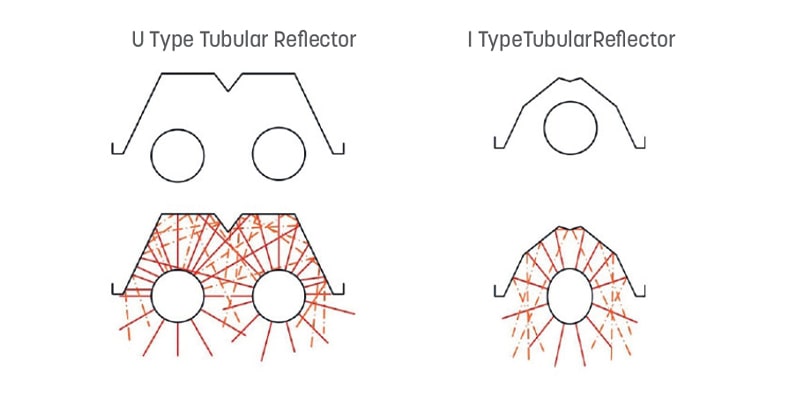
The radiation beams coming out of the pipe surface area are indicated by red color (straight line), the beam beams reflected from the reflector are indicated by orange (dashed line). Normally, the radiation continues on its way, leaving a part of its energy on each surface it hits. The choice of material of the reflector (reflector) comes into play here, and it is desirable to reflect it as it is, without consuming the energy of the radiation incident on it. Aware of the importance of this, reflective aluminum material with high reflective properties is used in our products.
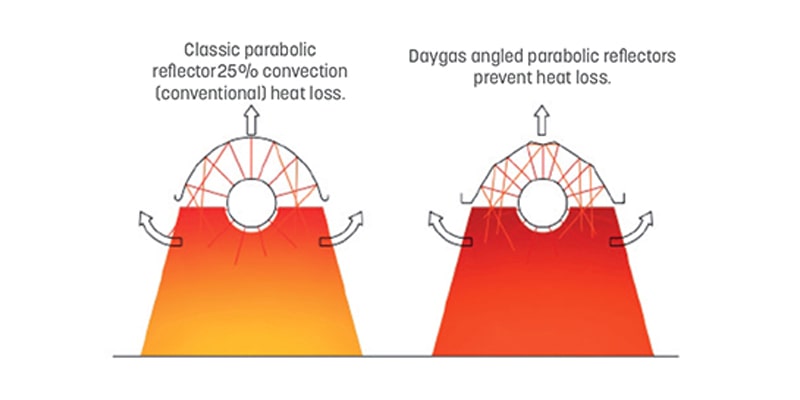
In tubular radiants, radiation occurs in the surface area of the pipe. In places where devices are hung, reflective, in other words reflectors, are used in tubular radiant devices to take advantage of the energy of the radiation that goes from the surface area to dead points (usually the part facing the ceiling). The use of a reflector reflects the radiation going to dead spots and sends it back to the desired environment / area, as well as supports the heating of the surface area more as a result of the radiation coming out of the pipe and hitting the pipe surface again, and increasing the radiation capacity due to this.
Radium Radiant Heaters Report
Emissivity
Emissivity is a dimensionless number that gives a measure of how well an object can emit energy compared to a black body. The ability to emit may depend on factors such as body temperature, the wavelength December considered for the energy emitted, and the angle of propagation of the energy.

According to Kirchhoff’s law, if the radiation emitting power of a substance is ‘E’ and the absorption coefficient is ‘α’, they are equal to each other in theory. In other words, the emission (or emission coefficient) of a body at any temperature is equal to the absorption coefficient.For real bodies, ε depends largely on the structure of the surface, and the radiant wavelength, the arrival of the beam, also depends on the surface temperature. For real bodies, the Decimation coefficient varies between 0 and 1.0 < ε < 1.
The Radiant Area of Radium Radiant Heaters

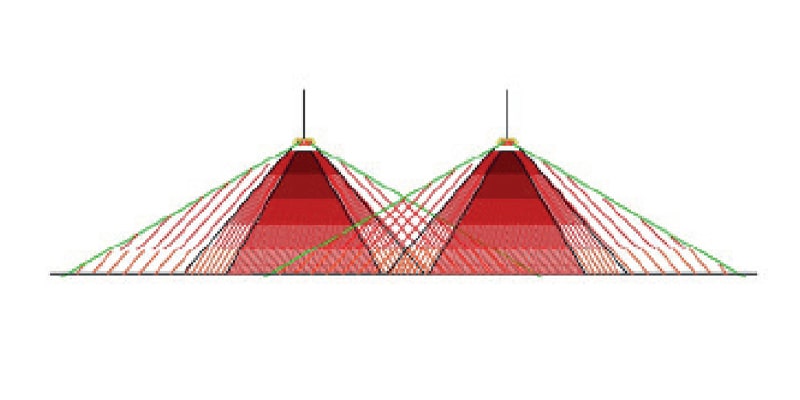
When designing tubular radiant device layouts, a layout plan is made according to the heat loss in the environment at the place where the devices will be used. The device layout design you see above, where insulation is sufficient and uniform heat distribution is not very important, optimal heating can be achieved by overlapping standard areas of influence. In this way, if the device layout plan, heat loss is high, insulation is poor or the air flow is strong in the environment where
the devices will be used, the intense radiation areas of the devices can be provided with optimal heating by overlapping each other.
The Radiant Area of Radium Radiant Heaters
When intersecting scanning angles, the intersection is made by taking into account not only the horizontal positioning of the devices, but also the hanging heights.
For example; Lets take the Daygas Radium 60 kW U tube type radiant heater device;
From the catalog data, the device min. hanging height: 425 max. hanging height: 1350 cm. Selectable radiant pipe meter within the capacity limits of the device: 9-15-18 meters When the design is made to have a radiant pipe of 9 meters and a hanging height of 6 meters at the place where it will be used; Standard scanning angle below one 60 kW U-tube radiant device at the specified hanging height and pipe meter;
Standard radiation length Lu : h*2
= 6*2
= 12 meters
Standard radiation effect width Lux : Li + (Lu/2)
= 9 + (12/2)
= 15 meters
Scanning Area = Lu * Lux
= 12 x 15
= 180 m² we reach its value.
If the place where this device will be used will be heated by staying under the intense radiation zone; the scanning area decreases to ~ 90 m². By intersecting this drop with the scanning angle of another tubular radiant, we can increase the scanning area up to 150 m².
The Radiant Area of Radium Radiant Heaters
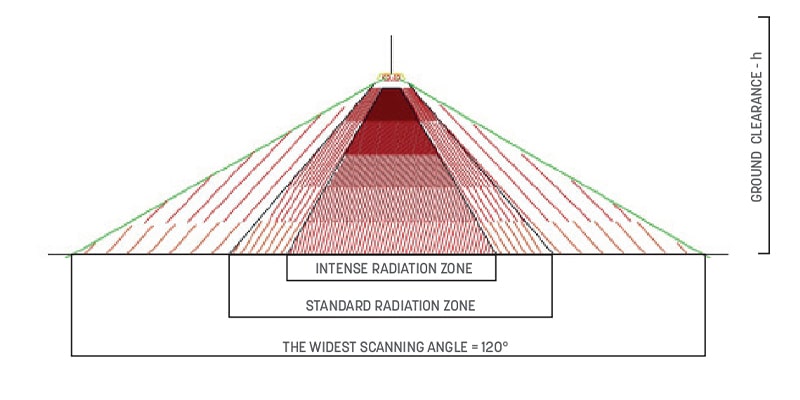

The most important parameter in the selection of tubular radiant heater capacity is the hanging height. In addition, the device capacity and type are selected as a result of providing comfort and safety conditions in the areas to be irradiated. In the drawing above, you can see the heating data obtained from tubular radiants, in other words, the radiation domains. When performing these calculations, the min given in the catalog values. and max. the hanging heights should be taken into consideration and the selection and number of pieces should be subtracted according to the area or environment where the heaters will be used.
Lj = h*1.2
Lu = h*2
Ljx = Li+(Lj/2)
Lux = Li+(Lu/2)
r: Radiant hanging height.
Device Controls
There are different scenarios and control elements related to controlling the devices.
If we express under the main headings;
- Remote control.
- Integration via control board.
- Pako switched manual control.
- Thermostat-switchedautomaticcontrol.
- Integration into the automation system. (Control via Scada)
The variety of control scenarios offered as 5 different alternatives allows the products to be managed correctly and in adesired way. The most appropriate control scenario is selected by evaluating the on-site use of the devices in our product range and the site conditions. Therefore, the control with the right solution scenario facilitates both fuel savings and long-lasting trouble-free service.

Integration to Automation System (Control over Scada)
Our devices can be integrated directly into building automation systems (bms) via modbus communication protocol via RS485 port (internal), or if there is no bms system available, the control of the devices can be used fully automaticallyfrom a single center via HMI touch panel or a PC.
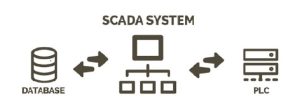
In the BMS System;
- Operation order of the devices on the specified days and hours,
- Operation of the heaters with regional or individual step and modulation control,
- Seeing the fault codes from the devices in the system and which device is the problem and keeping it in memory,
- Functional controls such as instant, daily, weekly or monthly monitoring of fuel consumption are the advantages of the automation integrated system.

Control Panel
- Password protection.
- Heat preservation mode.
- Freeze protection feature.
- 24/7 programmable feature.
- 128 x 64 graphic LCD display.
- Communication port with computer.
- Possibility of automatic and manual control.
- Ability to connect external temperature sensor.
- Possibility to control 8 independent zones and 32 devices in total.
It makes your work easier thanks to many commands, from the command to turn the devices on and off on the working days and at the time intervals you want, to keep the environment warm in the temperature range determined for freezing protection when the business is closed.
Analog Room Thermostat
Daygas analog room thermostat automatically turns off the device when the temperature value you have set is approached, and then when the ambient temperature drops below the desired temperature value, the device
automatically switches on at the maximum level and starts working again. In this way, it saves fuel.


Temperature Sensor
- Freeze protection mode.
- Possibility of modulating control.
- Temperature adjustment via the device.
When your devices approach the temperature you programmed with the Daygas temperature sensor, it provides fuel saving by reducing the modulation value of the device according to the weather conditions. When the environment reaches the desired temperature value, the device automatically shuts down, and then when it falls below the desired value, the device automatically switches on at the temperature level most suitable for the environment and starts working again.
Pako Switched Manual Control
With pako switched control, step adjusted manual control can be provided over the pako. For more local solutions where there is no control panel or it is not needed, the devices can be operated at the desired level via the paco switch. The heaters can be controlled with an independent step setting. Since the device is not powered on stand – by (0) position on the Pako, the device to be turned off goes to sleep after the closing procedures and thus long service
life of the devices is ensured.

Remote Control
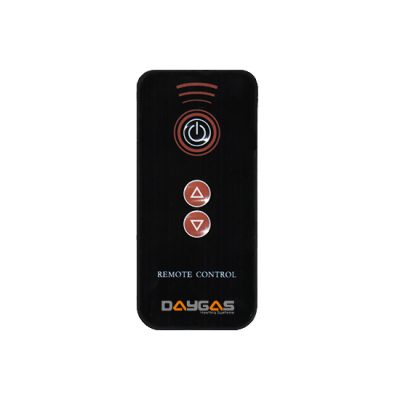
Daygas remote controls are simple-to-use control devices with 3 buttons and easy functions. Thanks to the Daygas remote control, all functions of the device such as on-off, heat setting up-down and reset can be easily controlled.
All Daygas products can be controlled remotely with a single remote.